Connect your operations.
Give people and AI agents the business context to understand dependencies, evaluate decisions and coordinate action across your company.
DATA → DECISIONS → ACTIONSTurn enterprise data into AI-enabled decisions.
CompanyOS connects information from ERP systems, machines, documents and files to the business objects that people actually work with, such as orders, materials, capacity, customers and payments. The ontology is an operational layer which brings together these objects, their relationships, business logic, calculation rules, and the impact of available actions in one coherent, AI-ready model. Permissions and executable actions provide AI agents with a practical means of investigating a problem, evaluating possible responses, and proposing an action or strategy for human review and implementation via connected systems. Both people and agents work within the same context, and the assumptions behind a recommendation remain visible. This creates a path from an incoming signal to a decision that can be reviewed, approved, and carried out.
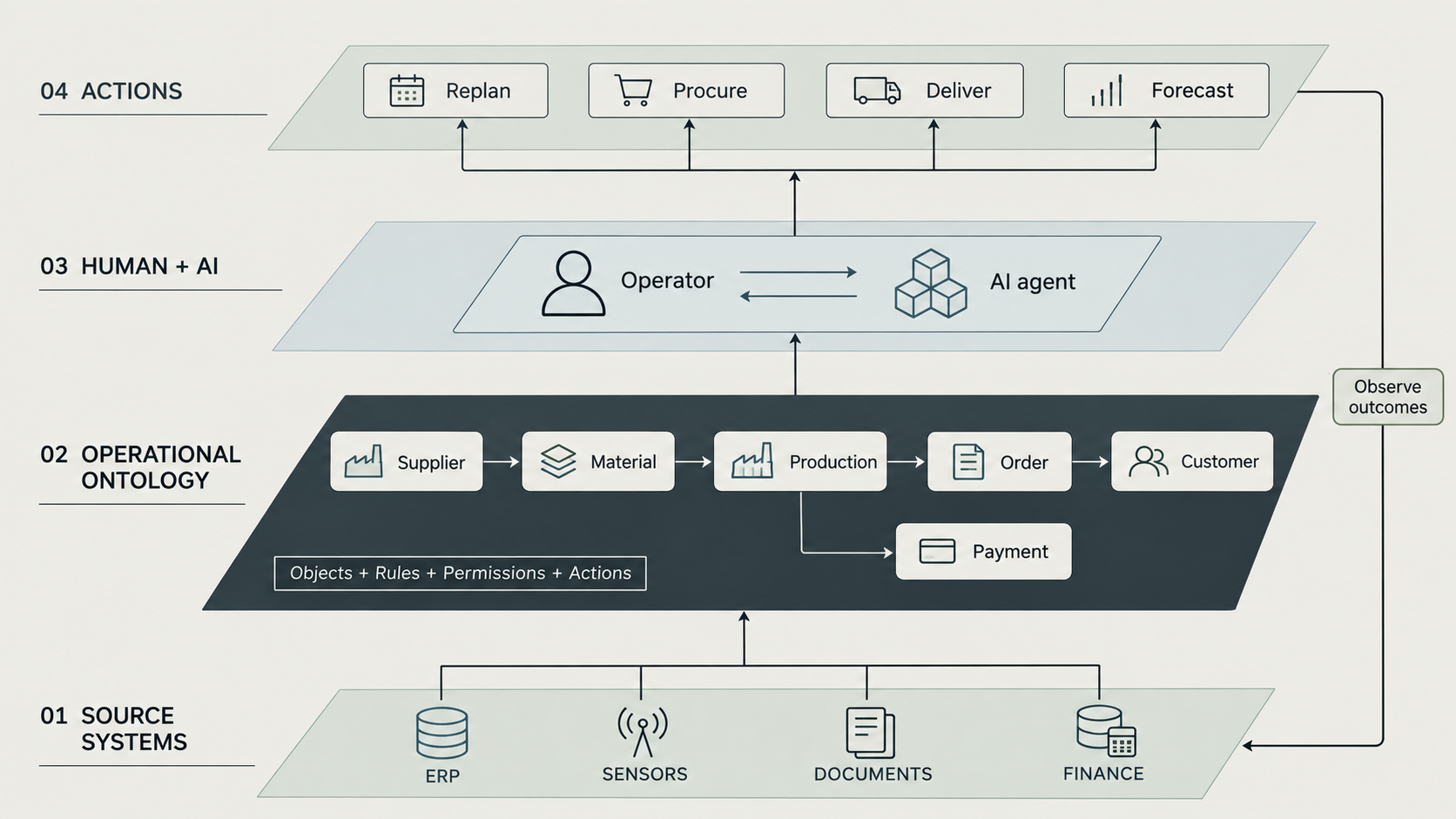
Connect existing systems
Bring ERP, sensor, document and financial signals into a shared business model.
Equip agents to reason
Link orders, materials, capacity and cash to calculations and permitted actions.
Keep people in control
Make assumptions, trade-offs and approvals visible before execution.
From organizational silos to functional business steering.
Current systems often provide effective solutions to local problems, but the consequences of a decision can affect several departments and the company as a whole. For example, a delayed purchase can change the production plan, jeopardise customer orders and delay cash receipts. CompanyOS provides operators and AI agents with an integrated view of the entire chain, enabling them to compare responses against delivery, capacity, margin and liquidity objectives simultaneously. This connected view can help companies evolve from vertical, department-centred ways of working towards a horizontal, holistic approach to business management. The system's value lies in its ability to follow, understand and optimise processes across the entire company.
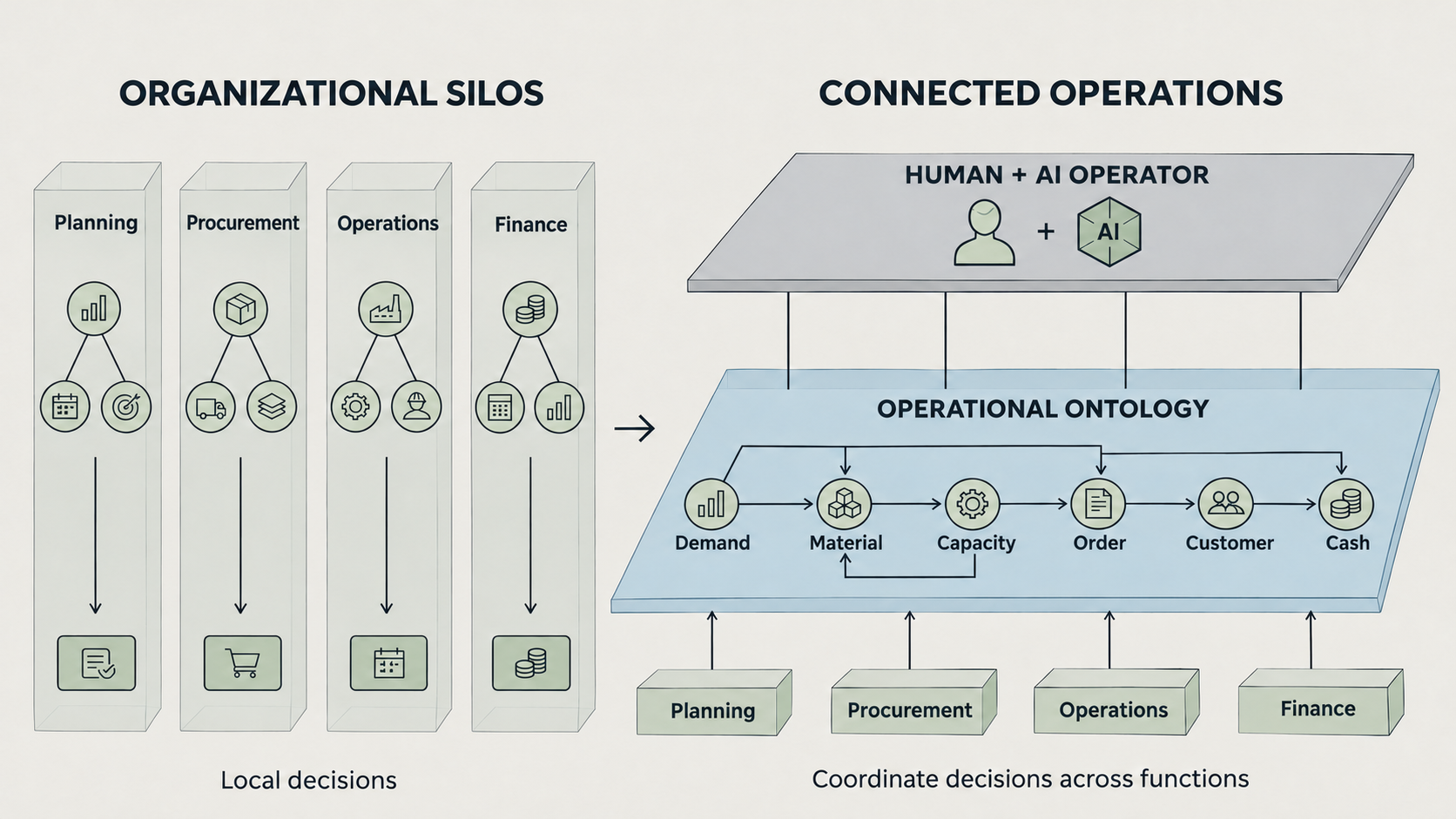
Monitor the full process. The target operating model follows connected events, flags exceptions and checks the effect of approved responses.
Resolve an operational disruption.
This example allows you to explore a business situation with an AI agent using connected company records. First, select a delivery delay, production outage or finance planning question. Then, describe what you want to understand or change. The example is based on a model of a small company, which uses an operational ontology to connect its customers, orders, materials, production, invoices and payments to business rules and executable actions. The agent uses this ontology, the scenario assumptions, and calculation tools to analyse the situation, compare responses, explain the financial consequences, and prepare actions for your review and approval. You are working with the underlying CompanyOS technology: results, along with their assumptions and sources, are generated after your request, and approved actions update the company model.
Investigate a delivery delay.
Average time to collect customer payments.
More planning assumptions
Orders, operations and finance share one company state.
No external business systems are connected.
Inspect assumptions and sources +
Responses are generated live from company records and calculation tools. Review the impact before approving a purchase, production plan or forecast. Approved changes are recorded in your workspace; no external systems receive instructions.
Contact
CompanyOS consulting and implementation.